
Yakima and Thule dominate the premium transport landscape, yet selecting the optimal solution hinges on load-bearing dynamics, vehicle architecture, stowage logistics, and detachment frequency.
Yakima prioritizes trail-hardened utility, engineering robust systems for enduro rigs, fat-tire geometries, and high-mass e-bike haulage.
Thule excels in mechanical refinement – prioritizing folding ergonomics, weight-conscious handling, and tactile finish. For heavy e-bike loadouts, analyze per-tray capacity: the Yakima OnRamp LX is rated for 80 lb per tray on the 2-inch hitch, while the Thule Epos supports 75 lb and the Thule Vero pushes 80 lb per tray.
In short: select Yakima if ruggedized utility, massive tire clearance, and raw value are prioritized. Select Thule if compact storage, engineering finesse, and daily usability are non-negotiable.
Yakima Vs Thule At A Glance
Both manufacturers offer comprehensive ecosystems – hitch, roof, trunk, and truck-bed options. REI’s bike-rack buying guidance correctly emphasizes that vehicle compatibility, hitch receiver specifications, load bars, and mass distribution must dictate hardware selection before brand loyalty.
| Factor | Yakima | Thule |
| General personality | Trail-hardened, utilitarian, robust | Refined, compact, premium-engineered |
| Strongest area | Enduro, e-bike, high-clearance hitch solutions | Intuitive folding, aesthetic fit and finish |
| E-bike focus | High-capacity, specifically OnRamp LX and StageTwo | Advanced ergonomics, specifically Epos, EasyFold XT, Vero |
| Roof rack style | Adventure-centric, modular ecosystem | Sophisticated, broad towbar ecosystem |
| Lock system | SKS, Same Key System | One Key System |
| Best buyer | Rider demanding structural integrity and utility | Rider prioritizing sleek design and storage efficiency |
A brand analysis only offers baseline insight. Exact chassis specifications matter more than corporate branding. A Yakima StageTwo and a Thule Apex XT solve divergent mechanical constraints, despite sharing a common hitch-mount interface.
Key Difference 1: E-Bike Capacity
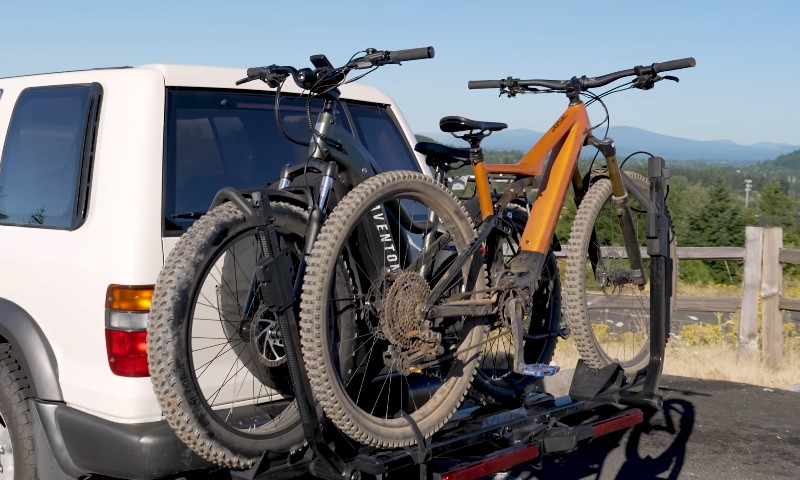
E-bike load-bearing capacity is the defining Yakima vs Thule differentiator in 2026, as modern e-bikes far exceed the static mass of conventional road, gravel, or hardtail platforms. REI advises buyers to verify maximum weight per bike first, ensuring rack load limits comfortably exceed the curb weight of all transported units.
Yakima maintains a robust heavy-haul lineup. The Yakima OnRamp LX is rated for 80 lb per tray on the 2-inch variant, with a restricted off-road rating of 48 lb per tray. The system features an integrated ramp, critical for loading step-through commuter e-bikes or large-casing fat-tire frames.
Yakima StageTwo provides a formidable alternative, engineered for e-bikes up to 70 lb, supporting 16-inch to 32-inch diameter wheels, tires up to 5 inches wide, and wheelbases between 30 and 52 inches.
Thule counter-engineers with high-performance e-bike racks. Thule Epos handles dual rigs with 140 lb total capacity, accommodating 75 lb per tray. Thule Vero elevates this further, reaching 80 lb per tray, positioning it as Thule’s most capable answer for heavy e-bikes and cargo-specific frames.
Best Answer For E-Bikes
For high-mass e-bikes, evaluate Yakima OnRamp LX, Yakima StageTwo, Thule Epos, Thule EasyFold XT, and Thule Vero.
Avoid roof-mounting for full-size e-bikes unless the system mass is optimized and vehicle roof-load limits permit. Lifting a 60 to 80 lb e-bike above shoulder height is physically precarious, even after battery extraction.
Key Difference 2: Hitch Rack Design
Hitch racks offer the most balanced kinematics for modern riders, keeping center-of-gravity low, reducing operator fatigue, and optimizing support for massive frames. Thule’s hitch-rack category identifies these racks as the premier solution for transporting standard and e-bike fleets securely and efficiently.
Yakima leans toward ruggedized, trail-tested hitch designs. StageTwo utilizes offset tray geometry for optimized bike-to-bike clearance, a StrongArm hook securing the front contact point, and integrated SKS locks. The 2-inch chassis expands from two to four units via the StageTwo +2 module.
Thule prioritizes tool-less modularity, compact folding, and stowage density. The Thule T2 Pro XTR manages two units, rated for 60 lb per tray, fitting 5-inch tires at a 52.04 lb base weight. It includes theft-deterrent hardware compatible with Thule’s One Key System.
Thule Epos maintains a weight-to-payload advantage, tipping the scales at 38.1 lb for the two-bike configuration while allowing 75 lb per tray. That engineering ratio grants Thule a distinct edge for users conducting frequent rack removals.
Key Difference 3: Roof Bike Racks
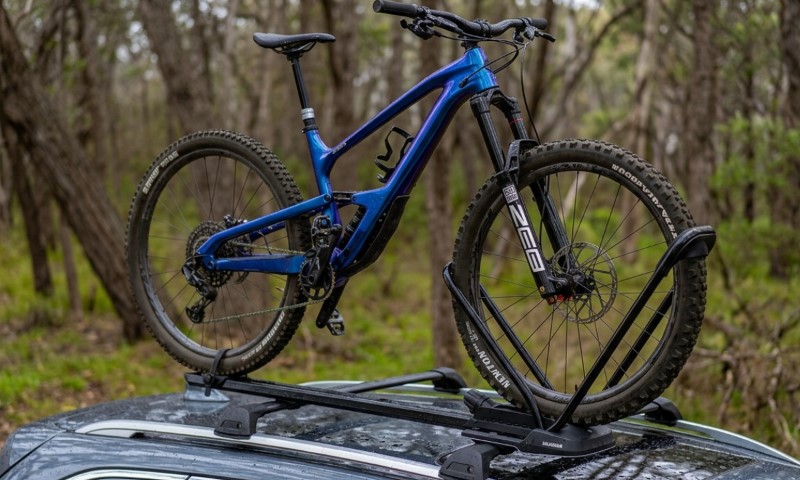
Roof racks remain viable for lighter builds, low-profile vehicles, and users demanding unobstructed rear-access clearance. For e-bike haulage, roof configurations are generally inefficient due to vertical load limits and lifting ergonomics.
Yakima HighRoad supports up to 45 lb per tray for road application and 27 lb for off-road environments. It accommodates crossbar spreads from 18 to 40 inches at an 18 lb base weight.
Thule UpRide supports units up to 44 lb, fits 20-inch to 29-inch wheels, and handles 3-inch tire widths – up to 5 inches with supplemental fat-bike interface kits.
Best Answer For Roof Racks
Yakima HighRoad and Thule UpRide are both suitable for road, gravel, hybrid, and sub-weight mountain bikes. Neither is optimal for heavy e-bike hauling. Yakima’s HighRoad possesses a slight road-use advantage at 45 lb versus Thule UpRide’s 44 lb, but operational selection typically hinges on bar compatibility, locking mechanisms, frame geometry, and regional availability.
Key Difference 4: Hanging Racks And Family Use
Hanging hitch racks provide cost-efficient transport for multi-bike family fleets featuring standard frames. They are suboptimal for carbon fiber structures, non-traditional frame geometries, step-through e-bikes, and high-mass loads.
Thule Apex XT features two, four, and five-bike configurations. The four-bike Apex XT supports 150 lb total capacity with a 37.5 lb per-unit weight limit. The five-bike variant mirrors the 150 lb total capacity and 37.5 lb per-unit limit.
Yakima RidgeBack serves as a comparable family-oriented hitch system, available in variable capacity options. Yakima engineers it as a tilt-capable rack featuring ZipStrips and folding architecture, arriving factory-assembled.
Best Answer For Family Bikes
For four-bike fleets, Thule Apex XT and Yakima RidgeBack represent functional choices. For premium carbon fiber, e-bike, or irregular geometry rigs, a platform-style tray rack is the superior standard, supporting bikes at the contact points rather than suspending them by the frame.
Key Difference 5: Storage And Handling
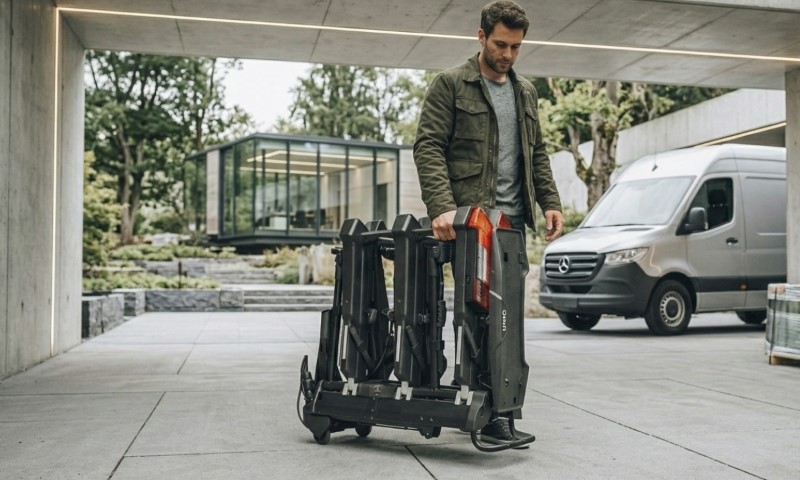
Thule generally leads in stowage footprint optimization. Thule EasyFold XT retracts to 31 x 12 x 26 inches, weighing 45 lb, supporting dual bikes at 65 lb each.
Thule Epos exemplifies storage efficiency: the two-bike iteration collapses to 27.6 x 11 x 30.1 inches at 38.1 lb. For apartment dwellers, shared storage spaces, and users requiring rapid deployment/removal, that mass-to-volume ratio is pivotal.
Yakima prioritizes utility-focused architecture. StageTwo maintains a higher mass profile than compact competitors, yet delivers superior tire-casing support, offset tray spacing, and e-bike-ready rigidity. Yakima StepUp Swing facilitates rear-access via a swing-away chassis, supporting two units up to 65 lb each.
A driver utilizing a compact hatchback and a single gravel build might favor Thule’s ergonomic, refined profile. A pilot commanding a 4Runner, Tacoma, Bronco, or camper setup may necessitate Yakima’s trail-ready robustness.
Key Difference 6: Locks And Security
Yakima deploys the SKS, Same Key System, across diverse rack assemblies and auxiliary equipment. StageTwo integrates SKS hardware to secure bikes to the rack, and the rack to the vehicle receiver.
Thule leverages One Key System interoperability. T2 Pro XTR integrates both frame-to-rack and receiver-to-rack locking hardware, while EasyFold XT provides security, though noting that locks deter unauthorized access rather than eliminating it. Thule advises auxiliary high-tensile cable locks for comprehensive theft deterrence.
Security caveat: no brand renders gear theft-proof. Integrated locks mitigate opportunistic theft at transient stops. For extended overnight exposure, detach the cargo or implement industrial-grade secondary security.
Model-By-Model Comparison
| Use Case | Yakima Option | Thule Option | Better Fit |
| Heavy e-bike | OnRamp LX, StageTwo | Epos, Vero, EasyFold XT | Parity, per load dynamics |
| Fat-tire mountain bike | StageTwo | T2 Pro XTR, Verse, Epos w/ straps | Yakima exhibits trail-focused bias |
| Compact storage | StepUp Swing if rear access required | Epos, EasyFold XT | Thule |
| Standard family bikes | RidgeBack | Apex XT | Parity |
| Roof-mounted road bike | HighRoad | UpRide, ProRide XT | Parity |
| Frequent removal | Consult lightweight Yakima options | Epos, EasyFold XT | Thule |
| Off-road trailhead use | StageTwo, OnRamp LX (reduced load ratings) | T2 Pro XTR, Apex XT (specified limits) | Application-specific |
Which Brand Is Better For Mountain Bikes?
@livingadvantageous
Yakima demonstrates an engineering advantage for mountain bikes when tire-volume, wheelbase-length, and trailhead-robustness are critical variables. StageTwo accommodates tires up to 5 inches, wheel diameters from 16 to 32 inches, and wheelbases extending to 52 inches.
Thule remains competitive for mountain platforms. T2 Pro XTR accommodates 5-inch tires and wheel sizes from 20 to 29 inches, maintaining 12.5 inches of inter-bike clearance.
The deciding factor is clearance. Mountain bikes featuring wide-sweep bars, elongated wheelbases, and heterogeneous frame sizes can suffer interference if tray spacing is insufficient. Yakima’s offset tray geometry on StageTwo directly resolves this issue. Thule’s high-end platform systems manage spacing effectively, but users must verify compatibility against the specific geometry of their fleet.
Which Brand Is Better For Road And Gravel Bikes?
Thule frequently delivers superior refinement for road and gravel sectors, specifically where weight-savings, compact storage, and tactile hardware actuation are priorities. As these bikes typically exhibit lower mass, maximum rack-capacity becomes secondary to clamping mechanics, storage footprint, and mechanical silence.
Yakima persists as a formidable contender. Yakima HoldUp Classic supports two bikes, rated for 60 lb per tray, expandable to four units on 2-inch receiver configurations via add-ons.
For carbon fiber frames, tray-style systems securing via wheel contact are imperative to prevent structural deformation of fragile tube geometries. Always consult manufacturer guidelines regarding carbon compliance, aero seat-post tolerances, fender compatibility, and maximum tire width.
Which Brand Is Better For SUVs And Trucks?
Yakima aligns well with SUV and truck platforms, bolstered by its adventure-modular ecosystem and swing-away functionality. Yakima BackSwing retrofits many 2-inch hitch systems for swing-away operation, supporting a 250 lb load rating for rack and payload.
Thule suits SUVs requiring modular stowage and premium ergonomic handling. EasyFold XT and Epos offer superior stowage-to-volume ratios, while Apex XT Swing provides four-bike hanging utility combined with swing-away rear-access functionality.
Truck operators should investigate bed-integrated systems. Thule Bed Rider Pro secures two bikes, weighs 17 lb, and includes vehicle-locking hardware.
Fit Checks Before Buying
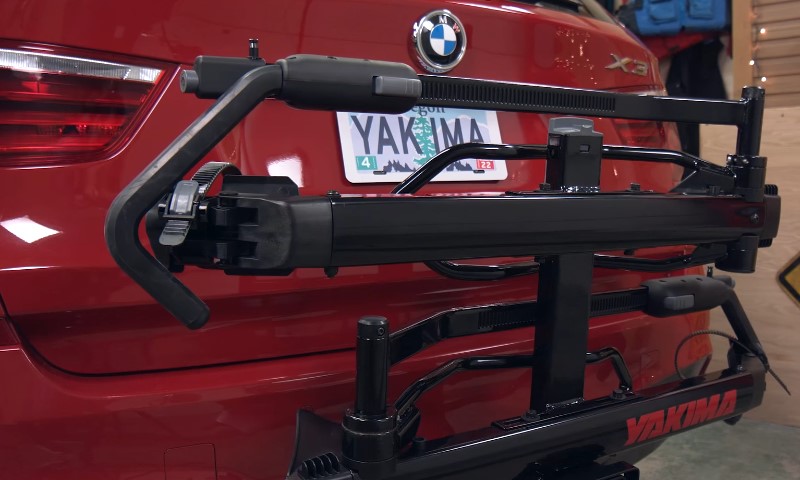
A high-performance Yakima or Thule rack remains suboptimal if the interface with the host vehicle is misaligned. Before procurement, audit five variables:
- Hitch receiver specifications: 1.25-inch versus 2-inch receiver compatibility is mandatory.
- Tongue weight and gross load: calculate combined rack and bike mass against receiver limits.
- Rear hatch clearance: analyze pivot-clearance or swing-away requirements for hatch access.
- Tire width and wheelbase: fat-bike and e-bike long-wheelbase compatibility is critical.
- License plate and lighting compliance: regional regulations necessitate visibility.
The Thule Serbia bike-rack page illustrates towbar, roof, trunk, RV, and truck-bed sectors, whereas Yakima’s corporate catalog covers roof, hitch, and trunk-mounted cargo ecosystems. Both architectures perform optimally when configured correctly; matching hardware to vehicle specifications is more critical than brand allegiance.
Price And Value In 2026
Yakima consistently delivers elevated perceived value where load-rating, durability, and raw utility are prioritized. List prices fluctuate based on iteration cycles, inventory levels, regional supply, and promotional periods – evaluate market pricing proximal to the purchase decision rather than anchoring to MSRP.
Thule justifies a premium price-point through finish quality, modularity, and ergonomic mechanical actuation. The return-on-investment is most pronounced when the hardware requires constant installation/removal, limited-space stowage, or multi-user fleet configurations.
Yakima’s value proposition dominates for riders prioritizing payload rating, fat-tire interface compatibility, trailhead resilience, and modular expansion.
The Final Verdict
Yakima represents the superior configuration for riders seeking rugged, trail-hardened platforms for mountain bikes, fat tires, SUVs, trucks, and high-mass e-bike transport. Thule represents the superior configuration for riders demanding precision-engineered, compact-folding, tactilely refined transport systems for daily utilization.
For the discerning buyer, the optimal procurement strategy is hardware-first, brand-second. Prioritize bike-load requirements, specifically for e-bike fleets. Then evaluate hitch interface, wheelbase metrics, tire-casing clearance, storage constraints, rear-access logistics, and anti-theft requirements. Only after defining technical specifications should you compare Yakima and Thule models within that class.
A final engineering heuristic: Yakima prioritizes trail-ready durability. Thule prioritizes engineered transport precision. Both manufacturers are reputable industry pillars. The misalignment of model specification to application will degrade user experience faster than the “incorrect” brand choice.